Dominic Rigby
Quadrillion-parameter transformers and how to train them
Date: 3rd November 2026
Key Points
- Humans are 1,000,000x more sample efficient than current AI models
- Chinchilla paper prescribed we need at least 20:1 token to weight ratio
- Human brain has ~100T parameters (synapses) and learn from ~200M tokens… the ratio 1:500,000. (My thought: this doesn’t include evolution as training)
- Token ratio is 10,000,000x lower in humans
- If humans had 5T tokens… they could train a quintillion parameter model
- Find that with their ensemble and multiple epoch method, they can get up to 300 parameter per token at 1e29 training FLOPs and that this keeps growing with compute.
- Why multi-epoch?
- Compute is growing faster than the amount of high quality training data
- Will therefore have to switch to a multi-epoch on same data
Results
- Find taht they can fit a model of the loss to:
- Number of unique tokens in the dataset, U
- Model size, N
- Number of epochs, R
- Number of ensemble members, M
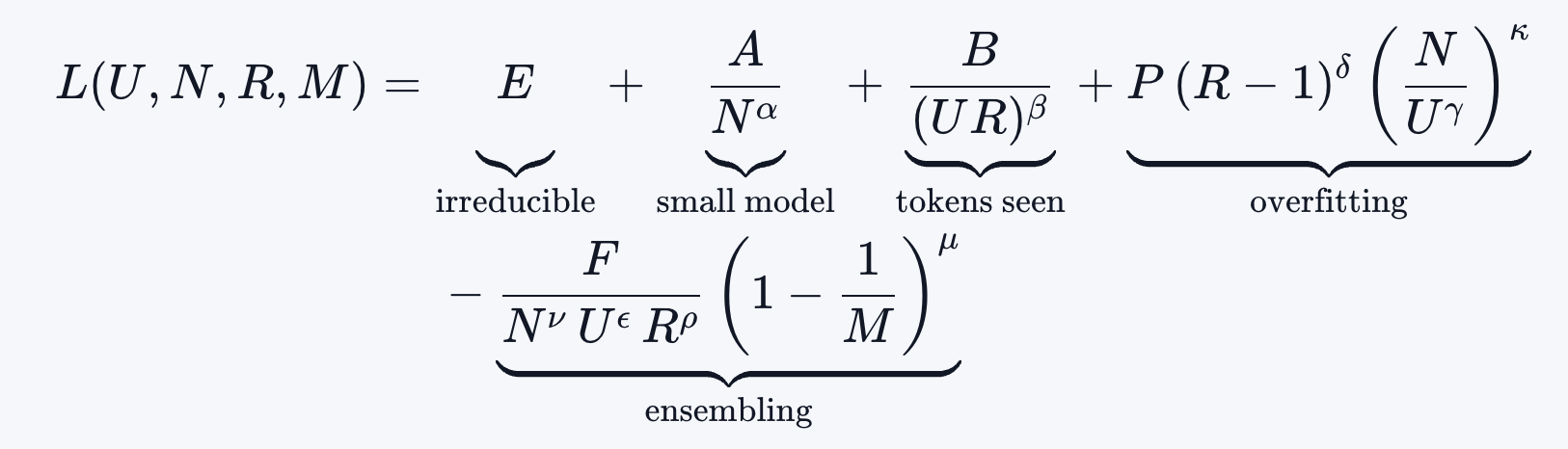
- Contains regularisation: larger models obvioously need more regularisation to prevent overfitting
- Find optimal weight decay scales rapidly with numbeer of epochs and model size
Key Methods
- Find compute optimal model size on fixed dataset with different number of FLOPs
- Aslo test multi-epoch training and ensemble of model training
- Snapshot ensembles:
- Take checkpoints from throughout training and average their output.
- Lowers loss at no extra compute cost
- To ensure models are diverse: train with cyclic learning rate and save snapshot at lowest point in sample
- They also Deep Ensembles which means multiple training runs.